 (Please let us have your feedback.)
 Loading...
A healer of metals
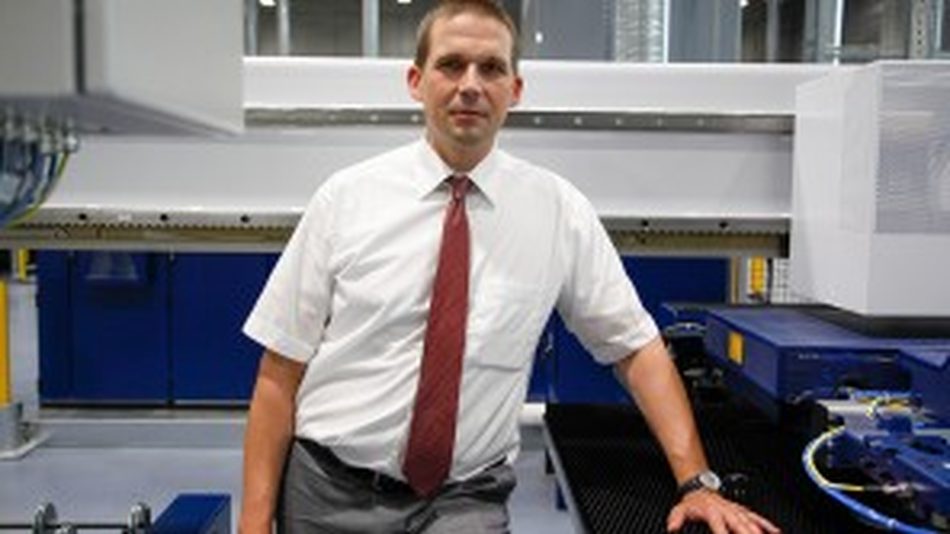
Dr. Michael Rohwerder is researching an intelligent corrosion protection system. Unexpected hurdles always motivate him to continue.
In industrialized nations, oxidation damage to metal consumes up to four percent of economic output. Corrosion protection is thus an important subject in metals research. Coatings equipped with special pigments were used for many years. But they turned out to be hazardous to both health and the environment. Ever more stringent legislation will force them from the market and out of the picture. For years, now, scientists have been searching for new ways to protect steel and other metals against corrosion, both durably and in an eco-friendly process.
Basic research
One of them is Dr. Michael Rohwerder of the Max Planck Institute for Iron Research (MPIE). This physicist has dealt with the properties of surfaces from the very start of his career. “This segment of physics is especially fascinating to me since, when working with surfaces, you always have an eye on a potential use but are still doing basic research,” says Rohwerder. In a highly promising project, he is investigating the use of conductive polymers for corrosion protection. To do this, the polymers are blended into a protective coating. The polymers are then activated as soon as the corrosion process starts. The polymers release active substances which flow to the point being affected. There they repair the corrosion damage and sheathe the spot with a new layer of anti-rust coating. “As early as in the 1990s there were vendors selling coatings containing conductive polymers,” says Rohwerder. “But protection was hardly reliable since, at that time, the knowledge base was not sufficient to design the layer appropriately. In some cases, these coatings even reinforced the corrosive attack. That was why they quickly disappeared from the market.”
The better you know the details of a subject, the more oft en you identify a solution to a problem.
“I was bothered by the fact that there was a fine principle out there, one with great potential, but one that had simply not yet been adequately researched so that it would work reliably,” Rohwerder explains. That is why he and his staff spent years trying to better understand the principle. He achieved success when he inserted capsules of conductive polymers into the coating. These functioned without being afflicted by the earlier problems. He also used a new process for activating the polymers: Its electrochemical potential changes as soon as a metal starts rusting. This change now activates the polymers present in the coating. “It will take quite some time before our findings become a product ready for industrial use.” In spite of this, Rohwerder has no lack of motivation. “The better you know the details of a subject, the more oft en you identify a solution to a problem. That always gives me a boost, even though the solution poses additional questions. Ultimately, the overall understanding of the topic grows with every step.”
Practice provides incentives
Seeing potential applications is mandatory for Rohwerder. “Oft en pragmatic questions open the door to new avenues in basic research. In addition, processes and technologies are often used in practice but one doesn’t know exactly how they actually work. If, following a change in the material, the coating no longer functions, then we have an exciting question for research.” In the future this scientist would be pleased to see that the results of his current research are being adopted by industry. “The coming years will see considerable changes in the field of coatings. If we are able to contribute our findings on conductive polymers in corrosion protection, then we would have reached an important goal.” www.mpie.de/corrosion
Any questions?
Contact us: MastersofSheetMetal@trumpf.com
This article was first published in autum 2015.