 (Please let us have your feedback.)
 Loading...
A twin pack for bending small parts
The first TruBend Cell 7000 showed convincing performance all along the line at Wincor Nixdorf – that’s why a second one had to follow on its heels.
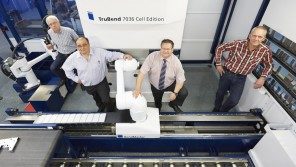
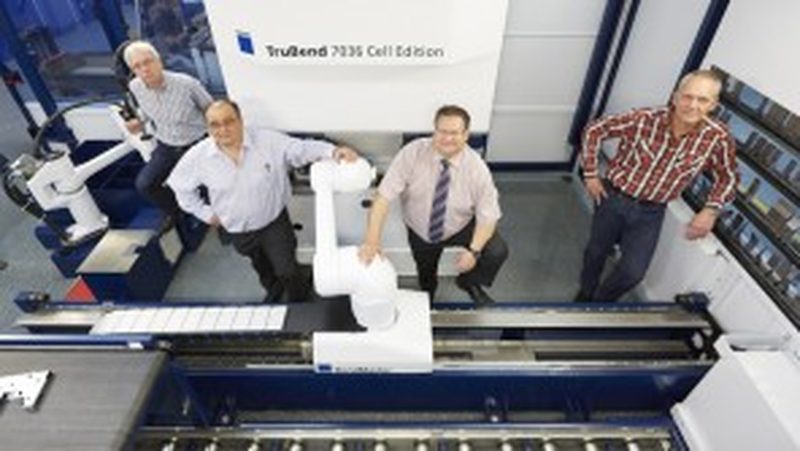
When it comes to bending, nobody can beat the Wincor Nixdorf team. Michael Schönbeck, Head of Production, Matthias Hillemeier, Head of Sheet Metal Processing, Manfred Wujesch, responsible for technologies and processes, and Michael Gramzow from Programming together have many years of experience to show for themselves. However, the TruBend Cell 7000 has really sparked their excitement. “The concept of the entire cell is simply unbeatable. A complete unit with components geared precisely to each other, that’s fantastic.”
The expectations for the bending cell were not exactly modest: “Faster, higher, farther,” says Manfred Wujesch in reply to the question of requirements and laughs. Wincor Nixdorf Manufacturing GmbH has been working with the fast, compact bending cell since December 2010. And Wujesch’s verdict is positive: “For me it’s a real innovation – the parts feed, the flexibility of the system pallets and the LoadMaster. The cell is simply well-rounded.” So well-rounded that Wincor Nixdorf has ordered the second unit, which has also been producing bent parts in Paderborn since November 2013.
Economical and continuous operation
As a test customer, the Wincor Nixdorf team has been familiar with the bending cell since its infancy and experienced its maturity to industrial scale production. “Automated production plays a very important role for us – we profit from the constant quality of the parts and significant cost savings,” reports Wujesch.
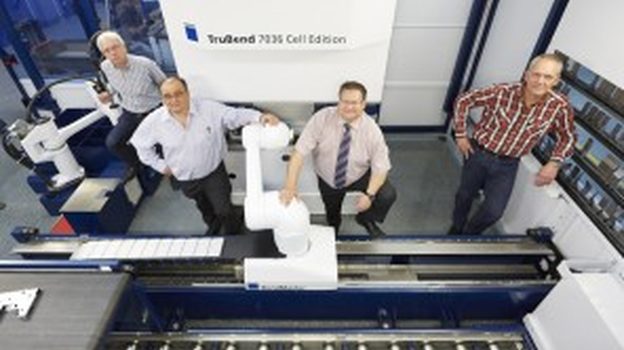
The company puts small parts measuring up to DIN A4 into shape with the fast, compact bending cell.
Production Manager Michael Schönbeck emphasizes that this is a major investment argument: “After all, our economic efficiency is one of the factors that determines whether we can continue to produce in Germany.” The two bending cells have shown convincing performance and now operate side by side. From Monday morning at six to Saturday night at 10 there is a machine operator nearby who looks after as many as three units at the same time – afterwards the machine works without an operator until the end of the production job on Sunday.
More parts
The company puts small parts measuring up to DIN A4 into shape using these machines. Mainly sheet steel in thicknesses from one to three millimeters for housing parts and internal components for cash machines, information terminals or cash register systems. “With the two bending cells we were able to increase parts output significantly,” reports Hillemeier. “That always depends on how complex the finished parts are. We now produce complex components in particular more reliably with the automated unit. With people there is always the chance that a part is turned around the wrong way and bent. That doesn’t happen to the machine.”
Millions of bends
Wincor Nixdorf produced 350,000 parts with 1.35 million bends on the TruBend Cell 7000 in the last six months. “And we accomplished that with reliably reproducible quality,” says Wujesch. Another figure provides evidence of the machine’s flexibility: “We produce 386 parts on the machine – the variety is thus enormous.” Some are repeated almost every week, others run only once every three months. That makes rapid and flexible adjustment necessary. This is where the ToolMaster Bend automatic tool changer comes in handy. Whenever a new tool is required, the BendMaster removes the one last used from the tool clamp and replaces it with the appropriate new tool. This minimizes setup times and prevents errors since the Tool Identification System (TIS) detects the type of tool and position automatically. In this way it is possible to complete different orders via an automated process. The TruBend Cell 7000 is thus an economical solution for production of small batches.

The LoadMaster Bend transfers the parts in the exact position to the BendMaster, which positions them on the press brake.
Simpler work processes
Two robots work in both bending cells. The LoadMaster removes the parts from the pallet, an integrated sensor measures them and transfers them to the BendMaster in just the right position. System pallets containing up to 24 different parts provide for flexibility here. Once the BendMaster receives a part, it positions it and after bending places it on the conveyor belt or in a wire mesh box. Programming for the two cells is carried out externally and they are integrated into the in-house production software. “The cleverly devised machine concept simplifies the work processes for us,” says Wujesch. “I don’t have to stop the machine to position parts into stacks. We do that outside the cell on the system pallets, then run them in and operation continues right away! This functions without any problems with different parts. A really clever overall system.”
Any questions?
Contact us: MastersofSheetMetal@trumpf.com
This article was first published in winter 2014.