 (Please let us have your feedback.)
 Loading...
An artisan in tone
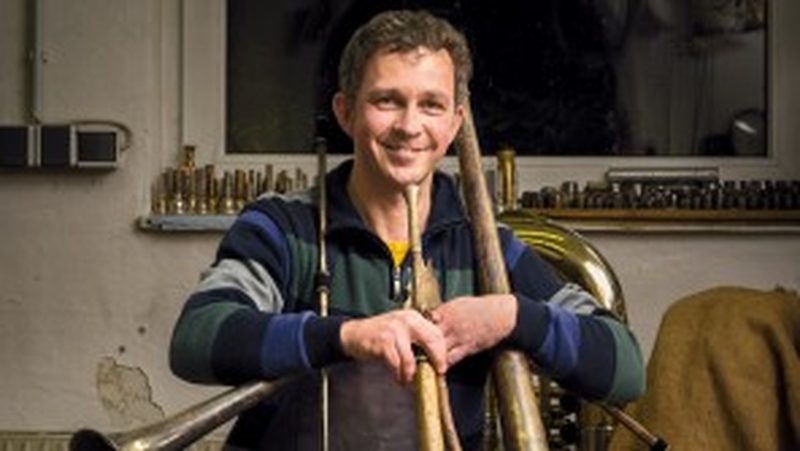
Walter Gamerdinger does not know what a fanfare sounded like in ancient Rome. But his replica instruments give us a pretty good idea.
The hammer strikes the gold brass workpiece countless times before Walter Gamerdinger is satisfied with the shape and thickness of the metal. Beforehand, he had marked and cut out the material, varying from 0.4 to 0.5 millimeters in thickness, using templates he made himself. A mandrel designed especially for the purpose is used for the shaping operation. He bends the blanks into shape on the mandrel. The butt joints are then soldered together with brazing spelter. Then begins the strenuous metal beating stage. Blow for blow, powerfully but with great accuracy, Gamerdinger shapes the instrument’s “funnel” — the so-called bell.
Hand-made replicas
After some 40 to 50 hours of work, he holds in his hands the result of his sweaty labor: an exact replica of a Roman tuba, cornu or lituus. “What the instruments actually sounded like over 2,000 years ago is a matter of pure conjecture,” says the instrument maker from the Swabian town of Aalen. In terms of appearance, however, Gamerdinger’s hand-made replicas are exact reproductions of their historical archetypes.

Walter Gamerdinger also uses tools he made himself to bend the blanks into shape.
A chance acquaintanceship
Walter Gamerdinger was musically inclined even as a child. When only ten years old he learned how to play the alto horn and trombone. Much later, when visiting a spa, pure chance led him to the workshop of a brass instrument maker and for Gamerdinger, then 33 years old, there was no question: This was the craft he wanted to learn. Originally trained as baker, he changed careers, obtained his master craftsman’s certificate, and opened his own shop at the beginning of 2000. Business was slow initially.
To while away the time, Gamerdinger began drawing up plans for replicating historical instruments based on drawings found in old school history books. He experimented, shaped his first bells and eventually reproduced a lituus. This wind instrument of Etruscan origin was used by the Romans as a signaling instrument well into the 4th century.
For the instrument maker, this first replica marked the start of a fascinating passion. In the meantime he has specialized in this sector and made a name for himself with his customers — private collectors, domestic and foreign museums, and theaters.

With a hammer Walter Gamerdinger shapes the gold brass workpiece.
A creative adventure
Every instrument made by Walter Gamerdinger is unique and has its very own character. “The visible hammer blows are intentional. I don’t polish my instruments either — they look as if they were 2,000 years old”, recounts the brass smith, now 46. When refining his techniques he adheres strictly to historical material and benefits from advice given by music experts he has met in museums or at Roman culture clubs throughout Europe. “Recently a young artisan foundryman cast two bronze mouth-pieces for me. In the future I will always use parts made like this. They improve my instruments by making the tone fuller and more intense.” Gamerdinger is quite sure on this point.
The butt joints are soldered together with brazing spelter.
Experimenting with materials
The casting is based on the imprint of an original mouthpiece, on display in a museum in Xanten and which even a specialist like Walter Gamerdinger is only allowed to admire in its showcase. “If there were a complete instrument, it would be interesting to hear what it sounded like. I can only rely upon my imagination and continue experimenting with materials and techniques,” he says. This is a creative adventure he is always pleased to get involved in. “For me it is a terrific experience every time an instrument is finished and I hand it over to an enthusiastic customer.”
Any questions?
Contact us: MastersofSheetMetal@trumpf.com
This article was first published in spring 2013.