 (Please let us have your feedback.)
 Loading...
Bending sheet metal stars
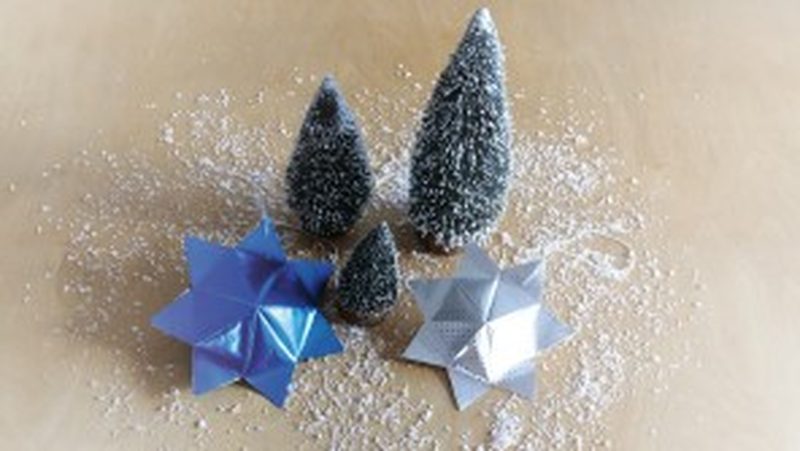
TRUMPF offers innovative TruBend press brakes for every need. But in case you don’t have one at home, then you can also bend thin metal foil into stars for use as a miniature Christmas surprise by hand.
Required materials:
Metal foil, scissors, glue stick, string, ruler, pencil.

Job preparation:
Cut out two circles of exactly the same size. For the inexperienced, the diameter should be no less than 15 centimeters. The smaller the stars, the more complex the bending and assembly process.
Bending sequence:
Bend one circle in half. Then bend the semicircle in half again and fold the resulting part again, edge to edge. Bend the second circle in the same way.




Pre-cut:
Locate and mark the center of the rounded edge. Then at the right and left, about three centimeters from the upper corners, make two marks. Cut along a line between the center and the marks on the edges, trimming away two identical triangular pieces.


Lay the bended but uncut piece of foil on the one that has been cut. They must be congruent and aligned at the ends of the points. Then cut the upper tip of the second bended part in exactly the same way as the first circle.


Assembly:
Open up both stars and cut each of them along one of the bended edges, through to the center. Glue the two adjacent surfaces together so that they are aligned. The stars are now arched. Bend the tips slightly toward the peak.




Apply a bit of glue to all the tips. Place a string for hanging on one tip and carefully lay the two halves of the star one on the other. Optionally, a small hole can be punched in a tip and the string attached there.


Retouching:
Minor unevenness after assembly (overhanging edges) can easily be trimmed with the scissors.
Uses when making larger batches:
Anyone who is producing multiple stars can join them with a long string and thus, for example, create a festive garland of stars.
Uses for batch size of 1:
Since this is a 3D-star, messages or small gifts can be placed inside.
Any questions?
Contact us: MastersofSheetMetal@trumpf.com
This article was first published in Winter 2015.