 (Please let us have your feedback.)
 Loading...
Builder makes his mark with quality
TRUMPF TPC 165 panel cutter: Irreplaceable for precision cutting in sandwich panels.
Today, most structures erected for both industry and the trades are built with sandwich panels. The reason: They are about 30 percent less expensive than masonry walls, can be erected far more quickly, and offer comparable thermal insulation values. At the same time, exactly dimensioned openings for windows, doors and gateways can be cut wherever desired. The essential prerequisite for this, however, is the TPC 165 TruTool panel cutter made by TRUMPF. That goes without saying for Reinhard Seiler, a professional builder of halls and a field test customer. “Anyone who wants to deliver quality in our industry simply cannot do without this tool.”
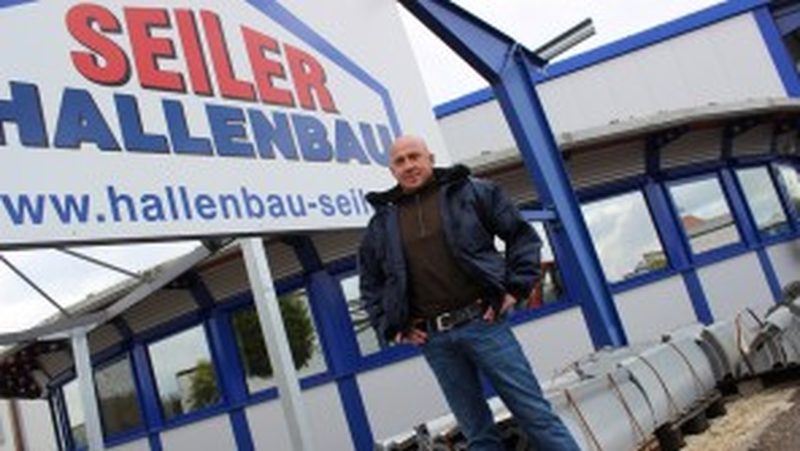
It was about 15 years ago that Reinhard Seiler founded his company, Hallen- und Gewerbebau Seiler GmbH, in Möttingen, Germany. In the meantime, that company has grown to a staff of 34 and annual sales of some 10 million euros. Asked about the secret for his success, he is quick with the answer: “Quality, reliability and speed.” The company erects about 60 buildings per year. The customers are almost exclusively involved in the trades and industry, firms asserting high quality demands. These include production and assembly companies from mechanical, electrical and heating engineering and metalworking. They are joined by auto repair and paint shops.

Once the lines have been marked exactly, a technician at the Seiler company, using the TruTool TPC 165 panel cutter, needs only five to ten minutes to make an opening in the sandwich panel.
Reliable employees
Always attentive to quality, Reinhard Seiler made sure that all the expertise needed was on hand in his own company. He does not use subcontractors because, in his opinion, they pursue their own targets and these do not of necessity coincide with his own goals. “I can rely one hundred percent on my staff. And that’s why our customers always get the hall they want and need, exactly on time.”
Seiler’s firm offers building construction work all from a single source. That includes planning and engineering, structural steel erection, roof and wall facades, and installing windows, doors and gates. The only thing not included in the firm’s range of services is pouring the foundation. “That is an entirely different craft and isn’t a part of our core business. But from the foundation upward, we’re absolutely unbeatable,” says the proprietor and goes on to explain. “Once the contracts have been signed, the order goes directly to our engineers. They make sure that we can always start assembly work in due time before the agreed completion date.”
Ready for occupancy in three weeks
On average, it takes three weeks to build a hall with 1,000 square meters of floor space, ready for occupancy, completely enclosed in thermal paneling, and including various windows and access doors. Erecting the steel structure takes about one-third of that time. Then the cladding is prepared and installed.
Polyurethane foam sandwich panels account for up to 98 percent of the walls Seiler installs. The panels are 60 to 120 millimeters thick – depending on the thermal insulation requirements. An example: An 80 millimeter thermal panel exhibits a transmission value of 0.29 W/m²K (thermal loss of 0.29 watts per square meter at one Kelvin temperature differential). Thus it is somewhat better than a brick wall 360 millimeters thick.
The TruTool TPC 165 cuts the openings für windows, doors and gates to exactly the right dimensions.
Good experience as a field testing customer
Before the walls have been set up and fixed to the steel structure with self-tapping stainless steel screws, it is necessary to mark and cut the openings the customer needs for windows, doors and gates. Seiler is convinced that only one tool can achieve the desired cutting quality and accuracy. “I had used several TRUMPF models prior to the current TRUMPF TruTool TPC 165 panel cutter and was always very satisfied. And, once again, the present machine makes a significant improvement in our work.”
Reinhard Seiler knows what he’s talking about, since his firm participated in field testing and thus followed the development of the new TRUMPF panel cutter, right from the initial drafts to the mass production launch. During this period, he and his associates tested the new design, hours and days at a time.
They also put forward several suggestions for improvements. These were accepted and implemented by the developers. The proprietor mentions one example: “We noticed that when topping up the chain lubricating oil, a few chips and dust might have gotten into the machine’s tank. If that were to happen frequently, then the lines might become clogged.” TRUMPF attacked this problem and worked out a very practical solution. Now a filler neck eliminates the danger of contamination and, at the same time, makes it easer to monitor the filling process.
Three times as fast with the panel cutter
Especially in the first year after he hung out his shingle, Seiler gained experience in cutting out openings without the panel cutter. “I used jigsaws and circular saws, but I was never satisfied with the quality.” Circular saws, for example, have one major disadvantage. Because of the round saw blade, the kerf is also rounded. And so the cut in the bottom sheet never reaches all the way to the corner. That makes it necessary to flip the panel over and finish the cut on the other side. Those cuts are never really aligned, making for inaccuracies. The whole process eats up time, too.
“The panel cutter lets me cut window and door openings three times as fast, on average. What’s more,” Seiler continues, “the massive hand-held saws used for this purpose are killers for the workmen. If I need to cut a panel 120 millimeters thick, the saws big enough to handle the task weigh about 35 kilograms. By comparison, the TruTool TPC 165, tipping the scale at less than ten kilograms, is a real featherweight.”
The cutter’s own low weight is achieved by using a stable sheet steel frame, replacing a heavier casting. To make sure that the assemblers can work for a long time without excess fatigue, the machine’s developers also adopted an ergonomic design for the handle. Over and above that, an optional guide rail simplifies precise cutting. This is especially helpful when cutting sandwich panels faced with a corrugated or box profile.
TruTool TPC 165 enables accurate inside cuts
Today this builder can immediately detect which tools were used, simply by looking at his competitors’ products. “When wide architrave profiles are installed around windows, doors and gates, the purpose is usually to cover shoddy work,” explains the company’s owner. He adds: “A jigsaw blade is never stable at its tip. That is why the cut in the lower sheet metal face will always be wavy.” The thicker the material, the greater the problem. The frames for windows, doors and gates can usually not compensate for these irregularities. What remains are small gaps which are concealed with a sheet metal strip or profile.
The panel cutter eliminates this kind of problem. The stable chain bar can be swung down for insertion wherever needed on the surface of the facing material. That means that the experts at Seiler can cut out areas in the middle or at the edge without drilling a starting hole – and even if panels have already been installed. “It’s like a hot knife through butter. That’s true even for extremely thick sandwich panels up to 165 millimeters in depth.”
To achieve the longest possible service life for the chain, TRUMPF has installed an automatic lubricator. Depending on the cutting direction and the nature of the material, a single chain can achieve up to 300 meters of cutting length. Whenever the chain or the bar needs to be replaced, this is done easily, even at the construction site, and in less than two minutes, as Reinhard Seiler confirms. One great help is that the combination key is stored in the machine itself, keeping it within easy reach.
Any questions?
Contact us: MastersofSheetMetal@trumpf.com
This article was first published in February 2014.