 (Please let us have your feedback.)
 Loading...
Down to earth
Ecology and economics need not be mutually exclusive. Roland Kiefer provides proof of this view.
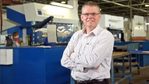
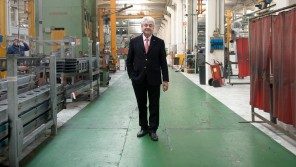
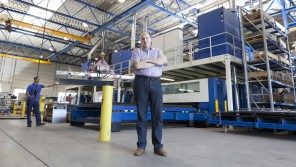
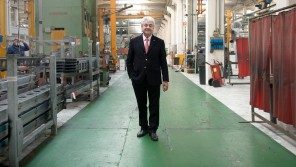
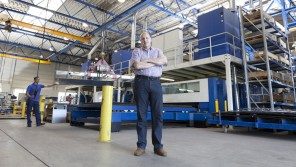
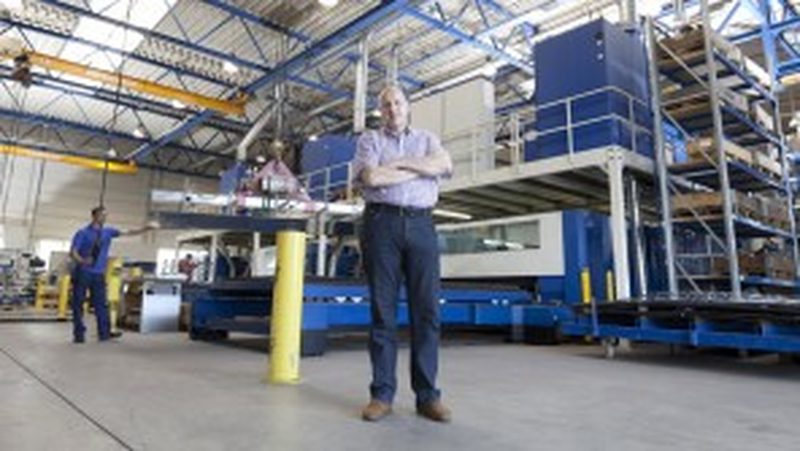
Roland Kiefer notes: “Taking one small step every day means that you’ve covered a great distance by the end of the year.” But, his first step was hardly tiny: In 2006 he took charge of Seeger Lasertechnik GmbH in the town of Lorsch. By now, three TRUMPF 2D flatbed laser cutting machines are in place at the production building with 1,600 square meters of floor space. Considering the high real estate prices at the junction of two major metropolitan areas — the Rhine-Main and the Rhine-Neckar regions — the manager came up with some exciting solutions for his production facility.
Not only is there a Stopa storage system reaching right up to the roof, it is ready for future additions to the plant. In addition, the switchgear cabinets for the three laser machines are located on platforms above the machines. This saves space and at the same time facilitates connection to the building’s utilities. That is an important aspect in Roland Kiefer’s view. In all his efforts to modernize and expand his operations, one aspect is primarily important for this go-getter: production that’s easy on the environment.
Sustainable for success
This mindset lets him cut energy costs and gain new customers, as well. He realizes that major companies especially are giving preference to environmentally-friendly producers when placing orders — provided that the manufacturing costs are comparable. Seeger is in good shape in this respect. The climate control concept makes a major contribution here. At the old location, the shop was warm in the winter and oppressively hot in the summer,” he recalls. “I wanted to avoid that in the new building.”
Today a geothermal energy system lays the basis for production without extreme temperatures and incorporates climate control in offices without requiring fossil fuels. When his facility was being built, Kiefer had forty geothermal wells, each thirty meters deep, sunk for this purpose. In the summer Seeger uses the temperature differential between the waste heat and the ground to cool the shop. In the winter geoenergy is used for the radiant floor heating throughout the building, including the administrative wing. The spaces are thus kept comfortable at little cost, all year round.
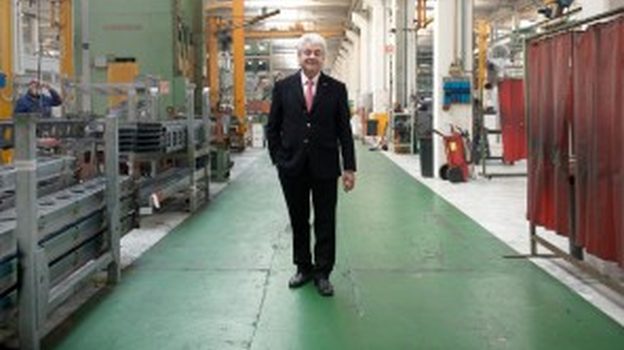
At Seeger the three TruLaser units are linked to the building’s climate control system by way of TRUMPF universal cooling interfaces.
The investment pays off
“Economics and ecology are not mutually exclusive,” Kiefer emphasizes, pointing to his three laser cutting machines. The TruLaser 3030, TruLaser 5030, and the TruLaser 5040 are linked to the building’s climate control system by way of the TRUMPF universal cooling interface. That lets Seeger recover the waste heat from laser work and that pays off. “Savings of about 20,000 euros per year mean that the capital costs will be amortized in just a few years,” Kiefer explains.
Although the geothermal energy system and solar collectors on the roof were planned from the very outset, the idea of recovering waste heat arose only after several talks with TRUMPF. The result: Seeger Lasertechnik is the world’s first company to use the universal cooling interface to connect its laser cutting machines to the building’s services network and to employ the waste heat in the geothermal energy system.
“Using our building’s utilities network to cool the machines was a fascinating task, especially since future additions to the building also had to be considered,” explains Kiefer, pointing to all the piping suspended from the ceiling. The building’s coolant circuit accepts the waste heat from the laser machines at the universal cooling interfaces and routes it to the geothermal system.
Efficient solid-state laser
This manager is particularly happy that — thanks to the universal cooling interfaces — there was no need to modify the laser cutting machines. The inlets and outlets are simply connected to the building’s coolant circuit. And that’s it. The interface is an accessory for the standard cooling unit. That means there is nothing to stand in the way of reselling the machine later. But Roland Kiefer is hardly thinking about selling his “blue-and-white” machines anyway. He’d rather plan the next addition to the shop, including another laser machine. He’s already got his eye on the TruLaser 5040 fiber with a highly efficient solid-state laser.
Any questions?
Contact us: MastersofSheetMetal@trumpf.com
This article was first published in autumn 2012.