 (Please let us have your feedback.)
 Loading...
Playing it safe
During initial testing under practical conditions at Oberschmidt, the new Trumatic 6000 proved to be extremely capable and reliable. Even when you leave it alone.
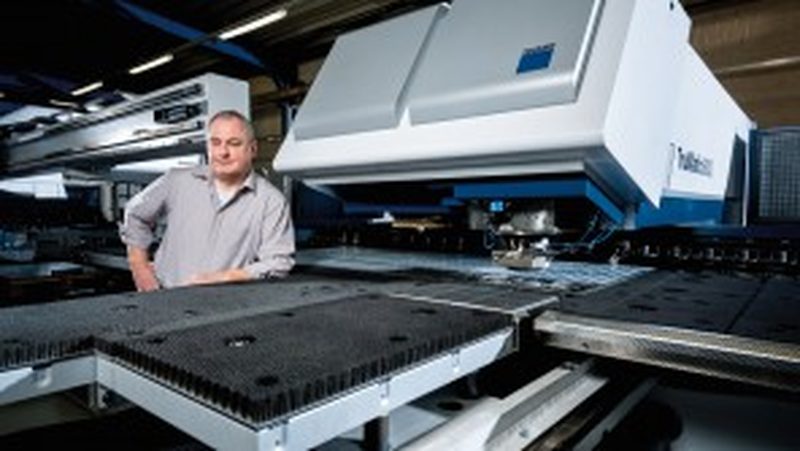
Whenever Michael Grave starts talking about the new TruMatic 6000, you can hear his enthusiasm: “Its high process reliability is especially impressive. I’ve been in this business for 25 years but have never come across any combination machine that is so dependable.” Grave is plant manager at Jörg Oberschmidt GmbH + Co. KG — since June 2012 a test customer for the new punch laser machine. Dieter Pfisterer, head of punch and punch laser machine development at TRUMPF explains why: “We select test customers who have a wide range of products, are innovative, and who are prepared to try something new. This is why we chose Oberschmidt as one of four test customers.”
This job shop runs unmanned shifts primarily nights and weekends and produces high-quality components made from thin sheet. At these times of day it is imperative that the machine works reliably, without constant supervision. Grave remembers: “One weekend during the test phase the TruMatic 6000 ran continuously for 42 hours.”
Process reliability and component quality
In his opinion, its dependability is essentially due to its new, TruMatic Assistance Systems and Smart Punch Monitoring function. If parts get jammed, for example, the TruMatic Assistance Systems will put things right. As soon as the sensor in the parts chute recognizes that a part has hung — irrespective of whether it’s on the punching or laser cutting side — the software will make the appropriate part removal flap vibrate. On the punching side, the die will drop while the punching head withdraws to its highest position, giving the sheet metal maximum clearance. On the laser side, the laser guard will knock the sheet metal out. The machine thus reliably discharges even small components, at all times. Further software features make automatic loading and unloading especially reliable.
The Smart Punch Monitoring function also contributes to superb process reliability. “When we run a lights-out shift there is always the chance that a punch could break”, explains CEO Jörg Oberschmidt. “In a worst case scenario, the machine might then produce scrap for ten hours. The Smart Punch Monitoring function prevents this.” This is how it works: After the last stroke and before the tool change, two photoelectric sensors check to make sure that a hole has in fact been punched. If not, then it is quite clear: the punch has been damaged. The follow-on tool stays in the magazine; the machine comes to a stop and sets off an alarm. It then uses TruTops Message to automatically send a text message, e-mail or fax to the machine operator, informing him about the situation. This function effectively prevents scrap parts.
Scratch-free parts
Yet it is not just the high process reliability that impresses Grave. Improved part quality is also important. The descending die ensures that sheet metal is processed without scratching. While the machine positions the sheet metal, the die descends, preventing damage. Part removal flaps are equipped with brushes to ensure the parts are not scratched when being ejected. “This is important because our customers expect the parts to be ready for further processing, straight from the machine. The need for reworking — polishing and brushing, for example — is minimized or eliminated,” comments Grave.
Always the right tool
Fast operations are important to the customers and to this specialist in thin sheet. It is for this reason that short tool setup and preparation times are a decisive cost factor, especially with short production runs. New functions incorporated into the TruMatic 6000 help reduce non-productive times.
One example is the single cutting head strategy, which increases flexibility in the new TruMatic 6000. On previous models, the operator had to change the cutting head manually to accommodate varying metal thicknesses. Now a single cutting head can deal with different material gauges.
Furthermore, an optional tool changer can be integrated directly in the SheetMaster. It provides enough space for 40 additional tool stations and is operated by the SheetMaster’s gripper. This integrated tool changer is an economical way of expanding the machine’s tool magazine — without needing an external ToolMaster. This means that the right tool is always available, even if you leave the machine on its own for a while. The intuitive control used with the TruMatic 6000 also scores with Grave: “To find out exactly how user-friendly it really is, I assigned a worker who had had no previous experience with it. He was able to operate it at first go.”
Teamwork of the highest order
As a test customer, Oberschmidt was able to participate actively in optimizing the machine. Grave feels this to be a great advantage. “We had a competent contact for every area involved — for the TruTops Punch programming system, for the machine itself, and for the machine’s software. The result of such close cooperation was teamwork at the highest level.” That was because TRUMPF experts supported the machine’s introduction right from the start and were able to respond quickly when improvement potential was recognized.
Both partners are more than satisfied with their close cooperation, as Dieter Pfisterer confirms: “Even though we always put a new model through its paces in our own factory, it is interesting to see how test customers use a new machine. When the machine then goes to market, our customers profit from the data we have collected and analyzed.”
Any questions?
Contact us: MastersofSheetMetal@trumpf.com
This article was first published in spring 2013.