 (Please let us have your feedback.)
 Loading...
Specialist and all-rounder
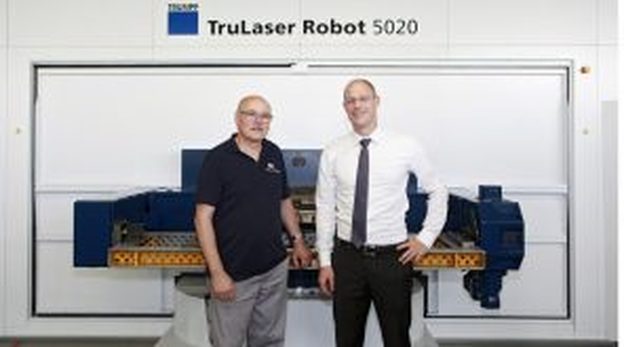
With the know-how gained from 17 years of laser welding and a TruLaser Robot 5020, Autz + Herrmann is conquering new markets.
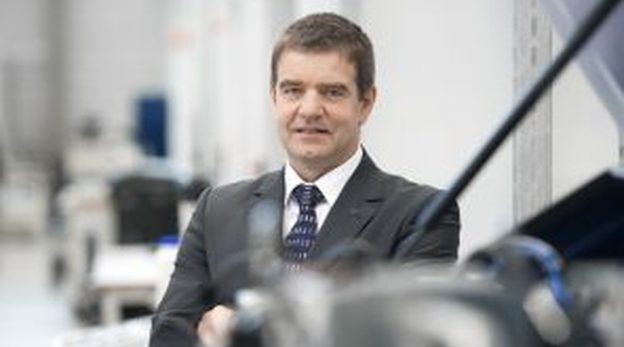
When the first TRUMPF robot laser welding cell was installed on systems supplier Autz + Herrmann’s premises in 1999, the approach was clear: We’ll use laser welding whenever there is no alternative – or only exotic ones. Today, Managing Director Florian Friedrich has a very different view: “Actually, we were able to use laser welding techniques to replace conventional manufacturing methods that were very time-intensive owing to very difficult upstream steps and a considerable amount of post-processing. Ultimately, this saved us loads of time, because once it’s up and running, then it keeps on working. For this reason, we’ll be laser welding even more parts in the future.”
This machine offers us a host of new possibilities. It’ll certainly make our work even more interesting.
At Autz + Herrmann, four laser welding systems process some 150 different parts in batch sizes of between 1 and 150. The pioneers from Heidelberg have established their laser welding know-how throughout the company. Through the purchase of a TruLaser Robot 5020 and the ability to also use heat conduction welding to join parts, the company is closing the final gap in its portfolio. “With laser tack welding, deep penetration welding, and heat conduction welding, we have a processing spectrum that allows us to weld a huge variety of components. We intend to use this flexibility,” explains Friedrich.
The TruLaser Robot 5020 is equipped with a 3-kW disk laser and offers numerous features that make laser welding more convenient. “For us, the motorized focusing option was important, allowing us to switch very rapidly between a heat conduction seam with low weld depth and a deep penetration weld,” says Florian Friedrich.
New possibilities
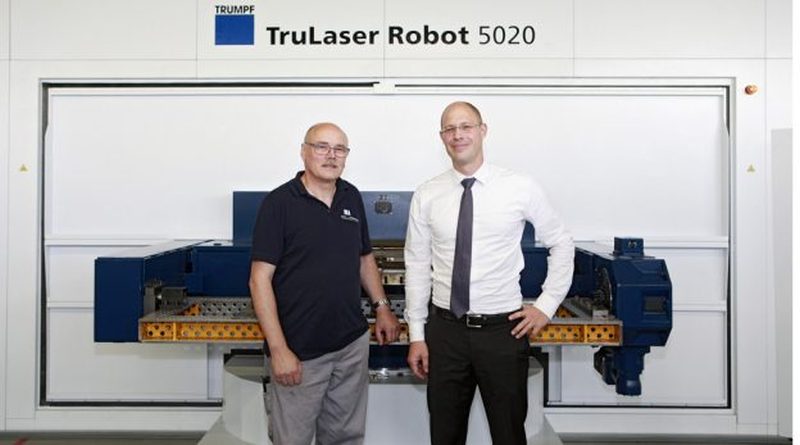
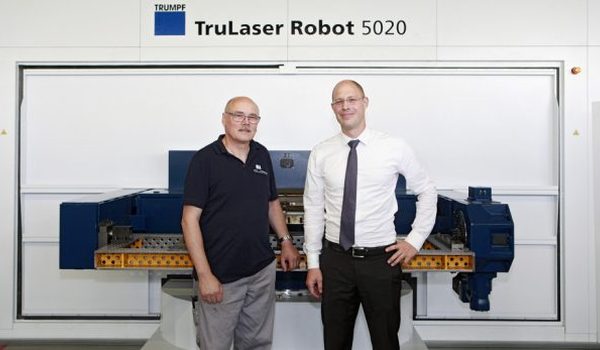
The plan to enter the world of heat conduction welding by purchasing the TruLaser Robot 5020 had been discussed before at Autz + Herrmann, as there had been frequent requests for this kind of work. The system is equipped with a 3-kW disk laser and offers numerous features that make laser welding more convenient. “For us, the motorized focusing option was important, allowing us to switch very rapidly between a heat conduction seam with low weld depth and a deep penetration weld,” says Friedrich. This is made possible by a programmable, movable collimator lens that automatically adjusts the focal position inside the optics. Other practical features include the built-in collision protection by virtue of the magnetic coupling on the laser head, and the TeachLine offline optical seam sensor system. It automatically corrects workpiece and fixture tolerances and ensures more stable processes. “This machine offers us a host of new possibilities. It’ll certainly make our work even more interesting,” says Otto May, foreman of laser welding operations at Autz + Herrmann.
At Autz + Hermann, all upstream manufacturing steps are designed around laser welding.
Autz + Herrmann manufactures its fixtures itself. And that doesn’t always have to be complicated. Sometimes simple clamping fixtures made of sheet metal do the job.
Know-how throughout the company
In practice, the many years of accumulated know-how serve the laser welding expert at Autz + Herrmann well. However, the company’s success in this field is not down to the expertise of a few “old hands” alone. “Laser welding affects several areas of the company – and that’s the way it has to be,” says Friedrich. “We design all upstream manufacturing steps around the method.” Even at the customer consulting stage, the company’s sales teams consider whether a part’s design is suitable for laser processing.
We save about 1,300 working hours every year on the manufacture of this part alone.
At the design stage – if not before – it is then determined whether a part can be redesigned for laser welding if required, and if so, how difficult, costly, and beneficial this would be. The issue of fixture construction also comes into play during costing.
Learning never stops
Autz + Herrmann manufactures the fixtures itself. To this end, Otto May and the design team use the Demmeler principle to create flexible fixtures for a wide variety of part geometries. “In the future, we want to expand our expertise even further. For this reason, we attended a fixture design seminar at TRUMPF,” says Friedrich. The goal is to use the specialist knowledge to also build fixtures from sheet metal. “Fixture construction is a core skill for laser welding. Knowledge about how parts must be designed, an idea as to what fixture is needed for welding and how much time and money it takes to build it – all that affects the costing calculations. Because everything is so interlinked here, I’m convinced it all has to come from a single source,” says Friedrich.
To also retain the corrosion resistance of stainless steels when welding and to avoid annealing colors, shielding gas is used when welding seams.
Very delicate seams are required when welding the patented revolutionary waste water heat exchanger created by the company Defined Energy, which is based in the Faroe Islands. Because the heat exchanger has to be liquid- and gas-tight, the professionals at Autz + Hermann use forming and low heat input.
The full range
In the future, Friedrich wants to continue manufacturing parts in-house that no one else is able to make: “But we’re also using the laser now to weld parts that we used to process by manual TIG welding. The high heat input and the large heat-affected zone involved in TIG welding meant that we had to spend 45 minutes post-processing one part. With laser welding, we now only need five minutes. This means that we save about 1,300 working hours every year on the manufacture of this part alone.”
With this stop, the weld seams are subject to dynamic stresses. In spite of this, the surface of the part must always remain even. Here, too, low welding energy is used in order to avoid distortion.
To further expand laser welding operations and to generally broaden the company’s reach, the Managing Director has a three-point plan. First, all existing products will be reviewed. Wherever advantageous, they will be redesigned for laser welding. Second, through a stronger customer acquisition push, Friedrich wants to make existing and new customers more aware of the technology’s benefits: “The edges created by fusion welding using a laser have a radius very similar to that of adjacent press-brake bends. In this way, we’re able to cost-effectively meet the frequent requests we receive that parts should look like they were made from a single piece.”
s if from a single piece: Thanks to laser welding, this housing for sensors is completely free of cracks and burrs – without the need for post-processing.
Third, Friedrich wants to offer brand new products. “There are parts that have to be dust-tight – such as the switching cabinets used in robotics, which today are often produced in Asia. Laser welding is a good solution for such products. They are uncomplicated to make, and the customer benefits from simpler, cheaper logistics. In addition, our customers have direct contact partners who can respond flexibly to structural design changes,” he says, citing just one of many examples.
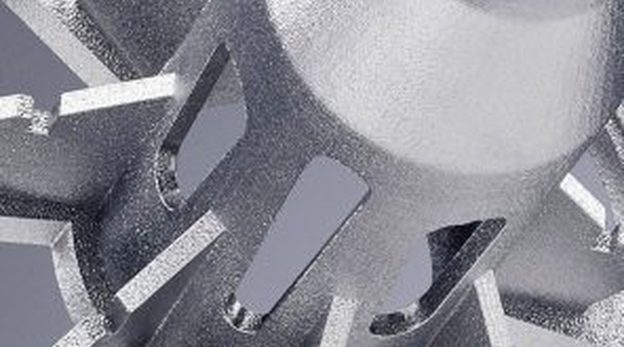
Heat conduction welding tolerates slight imperfections. When laser welding this steel part, no forming was required either.
All measures should be aimed at increasing machine utilization. Friedrich is confident that laser welding technology will bring him continued success into the future.
Any questions?
Contact us: MastersofSheetMetal@trumpf.com
This article was first published in autum 2016.