
 (Please let us have your feedback.)
 Loading...
At the peak
A new landmark is taking shape in New York City: One world Trade Center. Kammetal Inc., in the borough of Brooklyn, and the Christian Pohl GmbH in Cologne were instrumental in its erection.
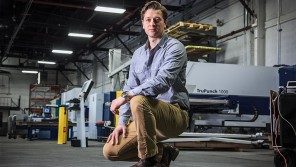
From his office in New York’s borough of Brooklyn, Sam Kusack looks directly at the Manhattan skyline — and at one of the world’s most closely watched construction sites: Ground Zero. For him, this is of particular importance since his company, Kammetal Inc., worked on the project there. “It is a great honor to have played a part in building One World Trade Center,” Kusack explains. That structure, also known as “Freedom Tower”, has been rising in Lower Manhattan since April 2006, on the site of the former World Trade Center towers. The design was created by architects Daniel Libeskind and David Childs. The Christian Pohl GmbH in Cologne manufactured the stainless steel frames for the building’s façade, while the top of the spire was fabricated by Sam Kusack and his team.
A commission for the very top
The fact that this American specialist for architectural and decorative metal elements was to build the “cherry on the top” — the tip of the spire — was something Sam Kusack learned in June 2012 while talking on the phone with the project manager at DCM Erectors, a steel contractor. “They were looking for a vendor for a special project. When we found that it was the beacon for One World Trade Center, we were raring to go!” This young businessman and his team had to exercise their patience for three months until it was clear that they — from among 15 companies — had been selected to manufacture the beacon cladding for the tip of the spire structure. Behind that skin a rotating beacon, much like a lighthouse, will illuminate the night sky over the city.
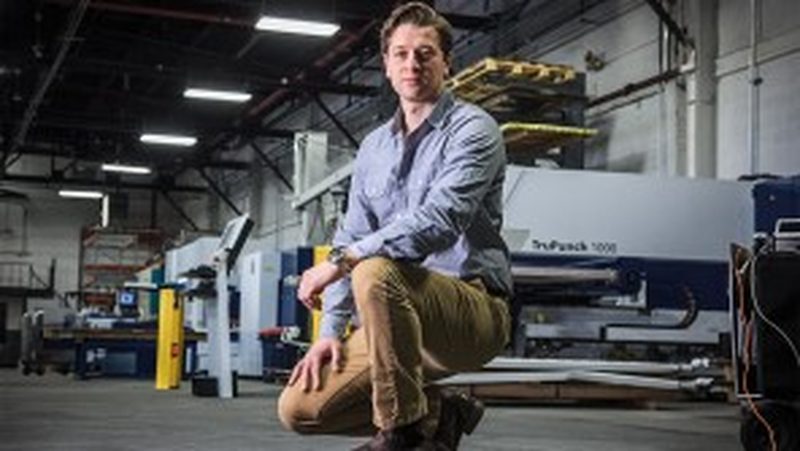
The pinnacle on One World Trade Center was installed in May of 2013. This was a very special moment for Sam Kusack.
Construction involved a stainless steel and glass structure, complex in its shape and 18 meters tall. “All in all, we fabricated seven tons of stainless steel and glass, and mounted the elements on a prefabricated frame,” Kusack explains. “At first glance, the overall design seems fairly simple. But it comprises thousands of individual components which our team manufactured and, in the course of the work, optimized again and again.” Kammetal cut the many different panels on a TRUMPF TruLaser 1030. “The speed and precision of the machine were decisive for the success of the project,” declares the company’s president.
A stormy start
Successful conclusion initially threatened to founder — literally. Hurricane Sandy struck America’s East Coast just as fabrication was to start. “Everything changed overnight,” Kusack recalls. In spite of every precaution, the shop was flooded by water from the storm surge, rising to a depth of about 70 centimeters. The TruLaser 1030, a TruBend 5170, and a TruPunch 1000 were damaged. The company received quick assistance from TRUMPF in the USA. While the TruLaser 1030 was being repaired, the U.S. subsidiary provided a machine on loan. As a consequence, Kammetal was able to complete the contract for One World Trade Center on time. In May of 2013, Kusack and the Kammetal team watched from their Brooklyn workshop as the beacon was hoisted and installed at its permanent resting point atop the spire.
The shell from Cologne
The preceding work in Cologne had been considerably less stormy. But the task for Christian Pohl GmbH was by no means less complex. That is why these experienced specialists for façades, who had already installed the skin on several high-rise structures in London, Paris, Chicago and Hong Kong, found the assignment especially fascinating. “This major contract was a very special project and a tremendous challenge,” relates the president, Heinrich-Robert Pohl, who took over the family shop and transformed it into a company active all around the world.
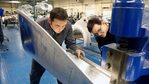
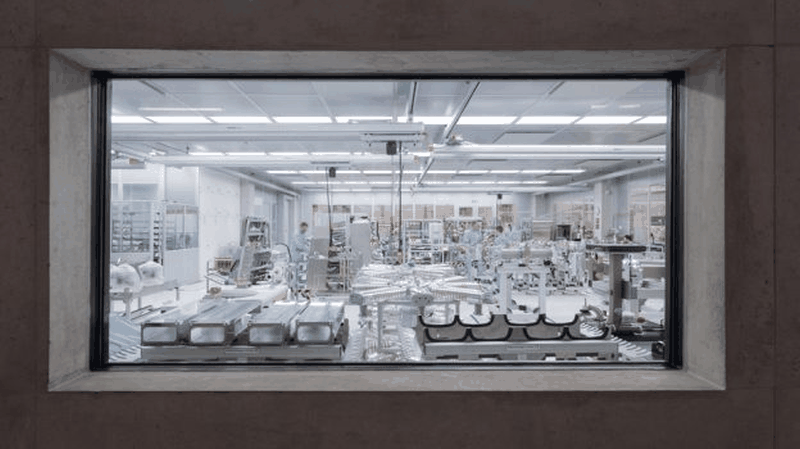
In spite of the relatively thin material the panels made by Pohl need to remain absolutely plain and resistant to buckling.
While tendering for this job, the American branch of the Cologne company came up with a special idea. It was with a specimen of the final matt stainless steel, mounted on a full-scale model of the façade, that the company was able to win out over international competition. The design of the entire building is just as sophisticated as the pinnacle. The striking feature is the rotation of the building, with its square floor plan, by 45 degrees as it climbs to the peak, becoming smaller in size. As a consequence, the tower’s façade itself twists as the tower rises. Pohl made up and delivered the complex stainless steel elements made of a corrosion-resistant chrome-nickel-molybdenum alloy. These elements are four meters tall, one meter wide and, taken together, weigh 250 tons.
Precise parts called for
Extreme precision was called for when fabricating the parts. “One of the major demands, in spite of the relatively thin material, was to ensure the flatness and stability of the panels even at high wind loads,” says Heinrich-Robert Pohl. The team was able to reliably fulfill this demand using a TruPunch 5000. Additional stiffeners on the rear surface of the panels ensure that they remain absolutely plain and resistant to buckling, so they cannot become detached and blow away. “At a height of 400 meters, violent winds can press and tear at the corners of the building — especially at the panels,” Pohl continues. During Hurricane Sandy, the elements proved that they could withstand such forces. With its peak made of glass and steel, New York City has, since May 2013, once again had a new landmark.
Any questions?
Contact us: MastersofSheetMetal@trumpf.com
This article was first published in autumn 2013.