 (Please let us have your feedback.)
 Loading...
briefkasten.de
For German readers, the web address couldn’t be any more intuitive. If you enter “briefkasten.de” you will be directed to Erwin Renz Metallwarenfabrik GmbH & Co. KG, located in the Swabian town of Kirchberg an der Murr. Renz is Europe’s leading manufacturer of mailboxes.
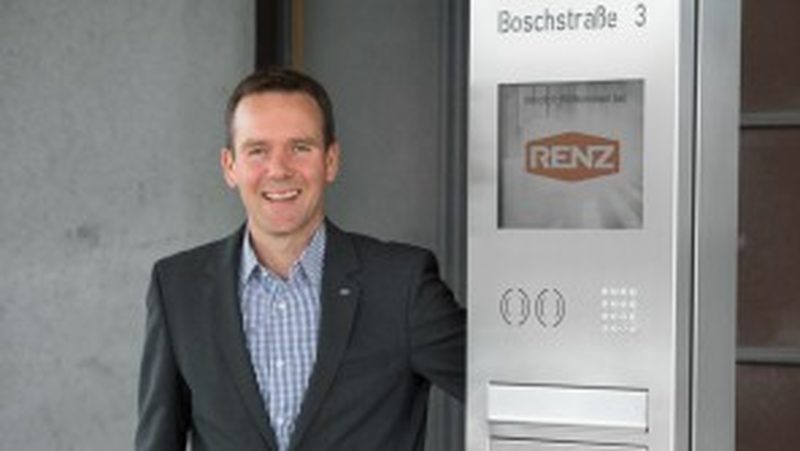
No matter whether it’s for a single-family home, residence buildings or very special commercial solutions for pharmacies and car dealers — whenever you need a mailbox, Renz are the people to contact. The company produces about a million mailboxes each year at its five European locations. At their headquarters in Kirchberg one mailbox is completed every seven minutes and almost each of them is unique. “One-off production has long been a reality at our plant,” says managing partner Armin Renz. “Around 95 percent of our mailboxes are produced to order.” Considering the enormous range of designs, Renz has done everything necessary to ensure that every unit is delivered to the building site on time and in perfect condition.
The key to smooth operation is the Renz Internet Configurator (RIC) — a soft ware tool unique in this industry. Following system prompts, a dealer uses RIC to specify a custom solution. The positions of doorbells and intercom units can be selected as desired, also true for the optional LED lamps, fingerprint sensors and Bluetooth interfaces. A feasibility check is performed at every mouse click so that planning errors are out of the question! The dealer receives a true-to-scale CAD drawing for approval before placing the order, along with a detailed quotation.
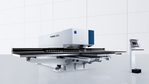
Customized front panels are created on a TruMatic 6000. The production scheduling section consolidates orders, taking account of the mix of materials.
What’s really clever is that RIC forwards to the production control system all the data needed for manufacturing. Once the order has been confirmed, the full data set is merged into the order books. The production scheduling section then generates a parts list at push-button command and then prints out the work order.
Around 95 percent of our mailboxes are produced to order.
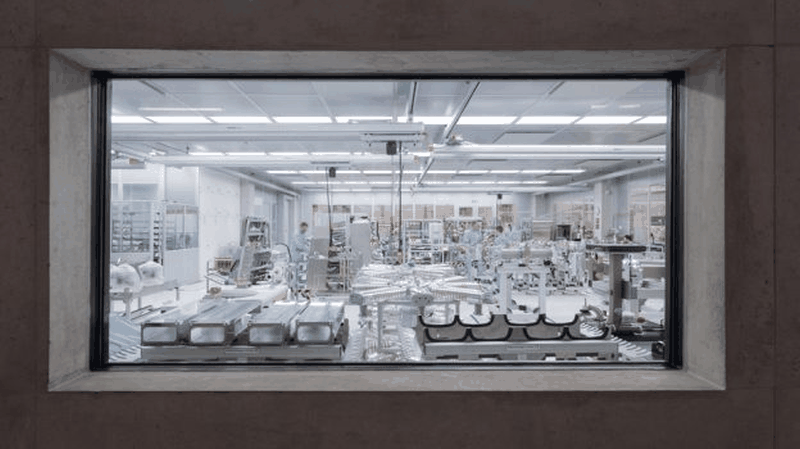
Renz manufactures the basic components – such as standardized boxes or doors — straight off the coil. The most widely used material for this process is thin sheet metal between 0.7 and 1.25 millimeters. Roughly ten percent are made of stainless steel. Aluminum is used even less. The lion’s share is made from corrosion-resistant Galfan steel. At present 120 different models predominate among the user-designed, highly automated housing lines. Housings are produced at a rate of one every 35 seconds.
Laser cutting and punching for one-off orders
The individualized front panels are produced on a TRUMPF TRUMATIC 500 R-13 punching machine and on a TruMatic 6000 punch laser machine. The production scheduling section pools various orders according to the mix of materials involved and thus combines jobs so as to conserve resources. Under no circumstance does the operator have to do any programming. On the contrary, he or she simply downloads the appropriate program for a particular order straight from a data-base using interface soft ware written specifically for this purpose. Both TRUMPF machines are also ideally equipped to change punching tools quickly. The punching head automatically exchanges the tools against those stored in the linear magazine. To guarantee high manufacturing quality during three-shift operations, regular maintenance work on all the machines has been routine for some time now. Armin Renz notes: “Our TRUMPF punching machine has been running for 17 years. One reason for its reliability is the maintenance contract. We are now talking with TRUMPF about a new TruMatic 7000 with an attached bending cell. That will make us more efficient when sequencing one-off punching, lasercutting and bending orders.”

A finished mailbox leaves the Kirchberg assembly line every seven minutes.
Renz attaches great importance to quality. For example, the tolerances for the puristic top-of-the-line series — dubbed Renz-Plan S — can easily be compared with those prevailing in the automobile industry. Smiling, he paraphrases something once said by VW president Martin Winterkorn: “None of our stuff rattles.”
Two-five-two with RSO
Plant manager Matthias Bethlehem and production scheduler Andreas Ginder continue to pursue their ambitious goal. Their medium-term aim is to boil down “Renz Synchronous Organization” (RSO) to a new formula called “2-5-2”: two-day throughput from the inquiry to order, five days for production, and two days for receipt by customers within a radius of 800 kilometers.
Manufacturing scheduler Andres Ginder and plant manager Matthias Bethlehem ferret out any kind of wastefulness.

“Kaizen” and lean management are routine manufacturing principles at Renz. “Kanban” trains deliver material reliably to the various work stations.
Many basic precepts drawn from kaizen and lean management have already been implemented. Instead of using forklift trucks, for example, they have a train that makes a “milk run” along a fixed route through the production hall, stopping at defined stations. It ensures strictly timed material flow and transports the right components to the right place. Kanban cards control material flow following the supermarket principle, i.e. self-regulated, closed-loop control.
Courageous cutbacks
The Renz RSO team has gone one step further. Matthias Bethlehem draws his conclusions from value stream analyses. “We want to keep everything moving. Every bit of fl oor space used for storage ties up capital, every wait means a delay for the customer. This is why we incessantly weed out waste of all kinds and are determined to reduce set-up and throughput times.” They long ago determined that shipping could be speeded up substantially by eliminating the dispatch warehouse.
Storage area? Far from it! The mailboxes go straight from the production line to the truck loading bay.
The carefully packed mailbox assemblies roll off the line and are moved straight to the truckbed — sorted by postal code. Their latest coup was to dispense with high bay shelving. Armin Renz explains: “We have reduced stock levels so drastically that the remaining floor space is enough for our buffer stocks.”
Perspectives in the digital era
In reply to any question about whether mailboxes have a future in the digital era, Armin Renz beams with confidence. “T h e number of really important letters is dropping but the volume of bulk mail and advertising material is on the increase. And the online trading boom has provided a golden opportunity for us.” Since the goods have to be sent to customers in parcels, the logical consequence for Renz was to develop new mailboxes for packages. This solution makes receiving and sending parcels just as easy as for letters. This is achieved by a lock with an electronic keycode, held only by authorized shippers and owners of a Renz parcel box. The recipient can also have parcels or returns picked up at home simply by placing the package in the parcel box. This is what the future holds for Renz in this day and age of the Internet.
Any questions?
Contact us: MastersofSheetMetal@trumpf.com
This article was first published in winter 2014.