(Please let us have your feedback.)
 Loading...
„Det ser ganska ljust ut“
“Things are looking really good!” The Swedish economy is taking off and metalworking companies are ready — with both highly automated machinery and new technologies.
Thirty kilometers to the south of Vänern, Sweden’s largest lake, lies Kvänum, home to a mere 1,300 people. That might not sound very spectacular, but this small town has grown into a lively center for sheet metal processing.
Bending and Punching
Niklas Tjäder is production manager at Swegon AB. The company manufactures air handling units and employs 375 people at the headquarters site in Kvänum. At present, nine thousand systems leave the factory every year — in a wide range of dimensions. “The smallest units are installed in refrigerators while the largest are the size of a travel trailer,” says Tjäder. They all have one thing in common: metal accounts for 95 percent of the material used. The outer and inner panels as well as all the parts inside are made of steel or aluminum. And it is aluminum that Swegon has used for a number of years to make fan wheels. “We used to make them from steel. But aluminum is lighter, and that saves weight and energy costs while maintaining the same level of performance,” Tjäder explains. The new material also brought a new technology into play: laser welding.
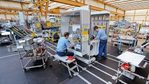
Swegon AB manufactures climate control and ventilation systems. “I want to set up a fully industrialized factory and modern production procedures,” says manufacturing manager Niklas Tjäder.
A TruLaser Cell 7020 with CO₂ laser now guarantees strong welds. Modern machines are important for the production manager: “I want to create a fully industrialized factory and a state-of-the-art production process,” he stresses. That makes automation an absolute must for him. In his production a Stopa storage system supplies three TruPunch 5000 machines with up to 450,000 standard blanks annually. Robots return the finished parts to storage. Tjäder also intends to automate bending in the future. “A high degree of automation is important for flexible, efficient production,” he believes. “What’s more, it guarantees constant quality and stable processes.”
More parts, fewer personnel
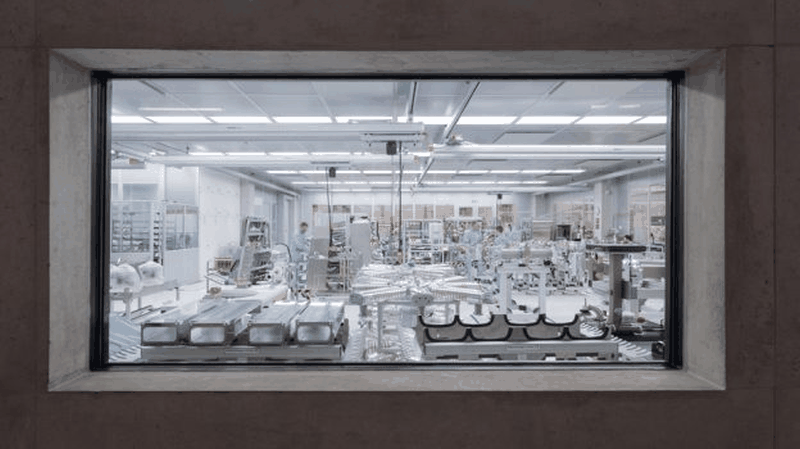
That’s Ingemar Ronger’s view, too. He works as managing director just one block away, in the Rotage AB production hall. The heart of his production operations could hardly go unnoticed. Seventy-five meters long and six meters high, the Stopa storage system provides space for nearly seven hundred pallets. This job shop works 6,500 tons of mild steel, stainless steel and galvanized sheet metal each year.
Three TRUMPF laser cutting machines and two punching machines are integrated into the automation concept, as are two fully automated bending cells. “With our automated machines we produce more with less staff. That represents a major competitive advantage,” says Ronger. “Our aim is to produce round the clock,” he stresses. Rotage dispatches shipments to as many as eighty customers a month, mainly in Sweden and Norway.
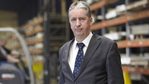
A thoroughly modern job shop, Rotage AB counts on automated production. “Our goal is to produce around the clock,” explains general manager Ingemar Ronger.
This requires a high degree of flexibility, because the lot sizes vary considerably: “We manufacture everything, starting with a batch size of one. Long production runs account for the major portion of our work, however,” says Ronger. In its job shop function, Rotage was hit hard by the crisis: “Within two months our sales fell by two thirds,” he recalls. Half the employees had to be laid off at the time.
But he also sees some benefits from the crunch: “Our approach to the market is now much more assertive and production is more efficient.” The result became evident in 2010, expressed as a 52 percent boost in sales. Ronger is already toying with new technologies. Laser welding has aroused his interest. “We intend to be Number One among the Scandinavian suppliers,” he stresses. “But we can achieve that only if we work with lean processes.”
Pioneering with BendMaster
Finding solutions and simplifying things, that’s the daily challenge faced by Per-Olof Björnsson 370 kilometers away, in Stockholm’s Skarpnäck district. “ProPart stands for Production Partner,” the managing director of Devex ProPart AB explains. “We want to stand by our customers at every stage of production.” From component design and optimization, and on to manufacture and complete assembly, the 57-strong family company can handle the entire gamut, if required.
“We develop components and products with the customers, and in this way we can avert any production problems arising from the design,” explains Björnsson. Some customers outsource to Devex individual parts or the entire job. “Many customers do not have their own production facilities or they lack the required expertise. We also help them optimize their production,” Björnsson stresses.
“ProPart stands for ‘production partner’,” explains Per-Olof Björnsson, general manager at Devex ProPart AB. “We want to be at our customer’s side throughout all the manufacturing steps.”
The company’s own tool department supplies customers with special tools for their machines. Maintaining market presence as a full-range supplier is a competitive advantage as far as Björnsson is concerned. Devex can provide everything: from laser cutting, bending, punching and milling through to MIG welding. The range of customers is just as varied: “It would be easier to list what sectors we don’t work for,” Björnsson says, laughing. “That would be the automotive and telecommunications industries. They need very big quantities and we mainly operate with small and medium-sized batches.” For the food industry, for example, Devex manufactures a machine to measure the fat content of milk. The parts are bent fully automatically. The two TRUMPF press brakes are augmented by the BendMaster: “We had the first one in Sweden.” stresses Björnsson. “Automation lets us match the competition in Asia, that is why we invested in a TruBend Cell 7000.”
Laser network for welding
Benny Gustafsson is also concerned about the long term. He is proud that, even in economically difficult tims, he didn’t have to let go of any of his workforce at Brantheim AB. “You should always give your employees and customers a feeling of security. That way you’ll have the necessary capacities when business picks up again,” he stresses.
He used the quiet times to train the nineteen employees at the family company, located twenty kilometers to the south of Stockholm, in laser welding: “We want to combine the agility of a small company with the capabilities of a large one,” Gustafsson says.
At the Brantheim AB job shop, general manager Benny Gustafsson wants to combine the flexibility of a small firm with the capabilities of a large one.
This is a strategy that breeds success. Despite the company’s comparatively small size, Brantheim has become firmly established as a full-range supplier. From laser cutting, punching, bending and lacquering to powder-coating, the company handles every stage in production — including 3D laser welding. “The technology has fascinated me for years.” When he discovered the TruLaser Cell 5020 at a trade fair, his mind was made up. Today, a solid-state laser supplies two machining cells and welds stainless steel hoods and enclosures for medical technology.
Other customers come from the telecommunications and electrical engineering industries, the food industry and the offshore sector. Brantheim produces everything from one to 8,000 units and turns out about 800 assemblies annually. Those are big jobs for a small business. “Automation is important for efficiency,” Gustafsson firmly believes. In his company two employees operate three machines — and do the programming, too. Just like Devex, Benny Gustafsson already invested in a TruBend Cell 7000 — one of the first in Sweden. It has a lot to do, since the volume of orders received is growing apace: “Det ser ganska ljust ut,” says Gustafsson — things are looking really good.
Any questions?
Contact us: MastersofSheetMetal@trumpf.com
This article was first published in summer 2011.