 (Please let us have your feedback.)
 Loading...
Space at last!
To ensure continuing growth in the future, the medical technology experts at Aesculap are counting on automation. This effort was, for a long time, stymied by the existing buildings.
 The tradition-rich buildings at Aesculap are a landmark in the town of Tuttlingen. Its more than 400 companies in the field of healthcare make Tuttlingen a global center for medical technology. Aesculap, with a staff upwards of 3,500, is the region’s largest employer. This medical technology manufacturer, today a part of B. Braun Melsungen AG, is celebrating its 150th birthday in 2017. A great deal has changed during this time and the company has grown steadily. But global growth is not the only firm’s target. It also intends to expand production space at the Tuttlingen headquarters — a clear commitment to Germany as an operating location. The lack of space in the existing buildings had become a full-blown problem for modern sheet metal processing. “To put a fine point on it: Things had gotten too tight,” says group manager Volker Huber.
Inefficiency simply don’t fit with our own self-image.
“As far as available space goes, we have worked right at our limit for some time. Sensible material flow could simply not be established.” The manufacturing lines no longer reflected Aesculap’s product diversity. “We work with far more than 150 different sheet metal varieties which, because of space limitations, had to be warehoused outside the actual manufacturing operations,” is how Joachim Bludau, the section foreman for sheet metal, describes the situation. Given the large number of products made by the company, handling warehouse logistics proved to be extremely complex. “This degree of inefficiency simply didn’t fit with our own self-image,” says Bludau. “Something had to change!”
A joint plan
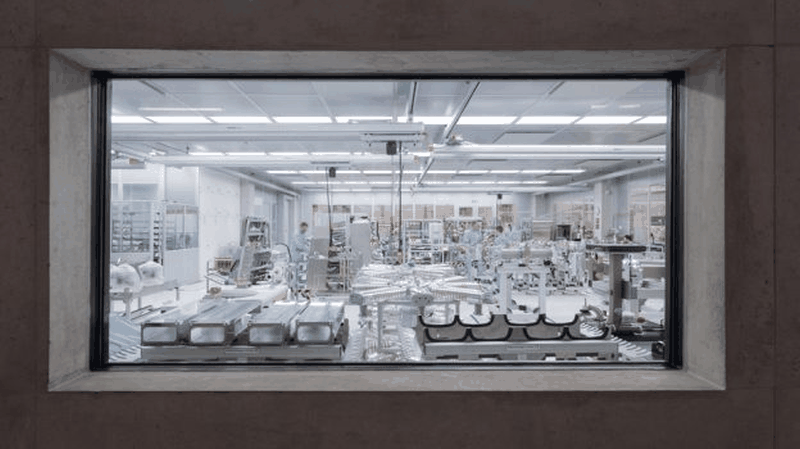
The Innovation Factory was dedicated in June 2015.
Continuous growth, both in the field of sheet metal processing and in certain other areas of the plant, offered a reliable foundation for expanding the floor space. The team assembled around plant manager Thomas Philipp decided, with the assent of the management board, not just to build a new production hall but instead a complete plant, including an office building. The new structure, in addition to production operations, was also to be home to the development and marketing departments. The plan for a new “Center of Excellence” was born. This marked the start of a construction running into the millions. “
From the very beginning we decided to use only modern, eco-friendly and economically sustainable concepts,” is how Philipp explains the approach. These ideas were reflected in the proposals presented in 2011 in the course of an anonymous design competition. The building was to be 50 meters wide, 25 meters tall, and 150 meters long — enough space to satisfy all the expectations of the Aesculap team.
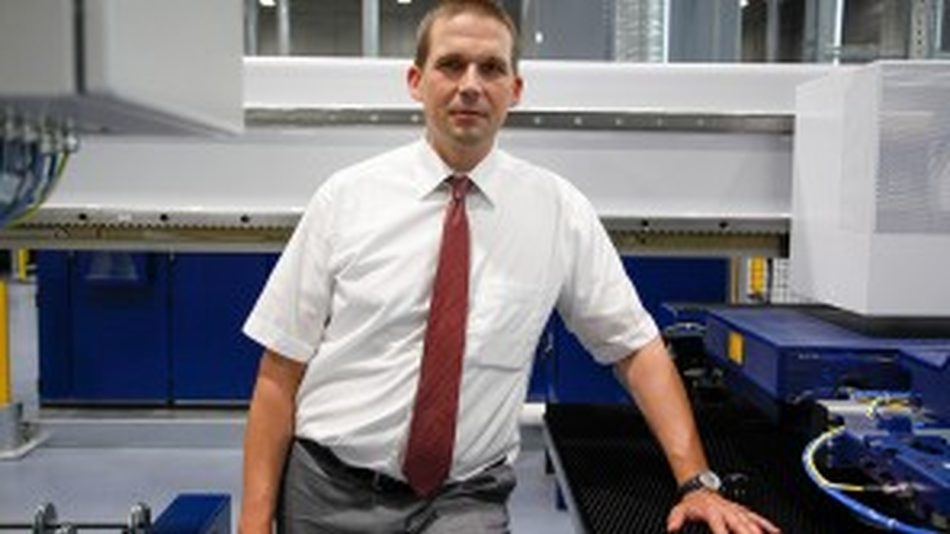
Group manager Volker Huber was a member of the planning team for newly purchased machines from the very beginning.
“Just a single row of columns supports the upper production floor, giving us the greatest possible flexibility when arranging the machines,” says Philipp. “To guarantee that the floor’s load-bearing capacity — three tons per square meter — would be reached, we decided on a design incorporating trusses.” Additional details — such as the heating concept, which uses only the heat generated by the machines — round out this thoroughly ambitious game plan. Project management calculated it could be completed within 15 months. At that moment, at the latest, voices were raised to say that this was impossible. “It was clear to me that if we applied our concerted efforts, then the schedule would be quite doable,” Philipp notes dryly. And he turned out to be right. In August of 2014 relocation into the “Innovation Factory” started, which was then opened by Federal Health Minister Herman Gröhe in June 2015.
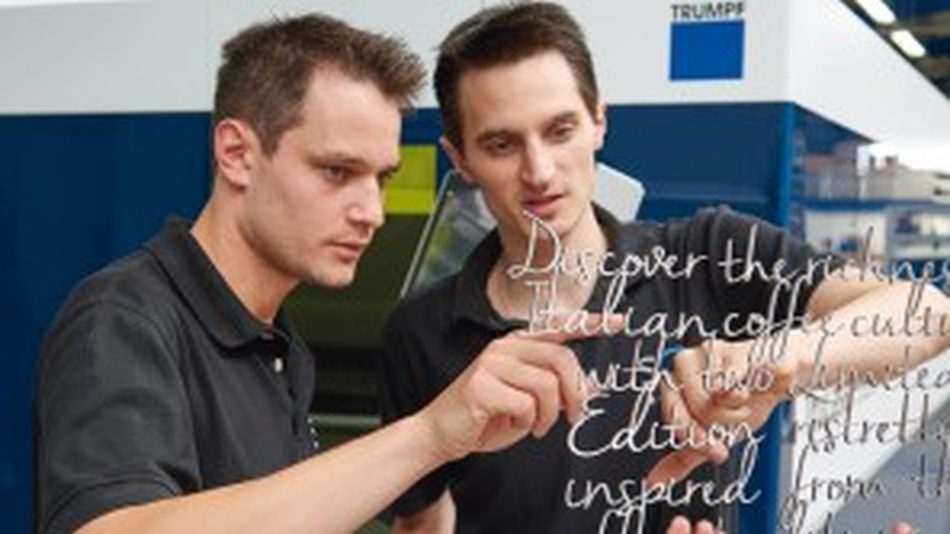
The section foreman for sheet metal, Joachim Bludau, collaborated with TRUMPF to work out an entirely new solution.

For instance an combination of a TruMatic 600 with a blower that cacuums away protective paper from beneath the sheets.
The paper seperates the sheets of metal, just one millimeter thick, in order to prevent damage. The plates are used in baskets for surgical containers, one of the prime products turned out by the sheet metal manufacturing line. A TruMatic 6000 punches the grid before the get folded during final assembly.
At last a chance to automate
At the Innovation Factory, the name is the objective. All the procedures are designed in accordance with the latest rules for process-oriented manufacture. “Beginning from scratch was truly a luxury,” says section foreman Bludau. The Aesculap team worked closely with TRUMPF to find the ideal solution. Together they visited many reference customers, considered new machine and automation concepts, and put them to the test at the show room in Ditzingen.

At Aesculap all machines working with sheet metal are linked to a Stopa storage-system.
The outlay for integrating all the unprocessed material into the manufacturing area, using a Stopa storage system, has certainly paid off. The majority of the manufacturing systems are automated and linked to the storage facility. New machines like the TruLaser 5030 fiber are fully coordinated with the steps of the process; that provides flexibility and reaction speed never seen before. The booking clerk enters the order into the system, and both the right kind of sheet metal and the appropriate program are sent automatically to the machine tool. “That’s exactly the way we had envisioned it,” says Bludau.
The ToolMaster can change out the punching tool in a matter of seconds.

It so ensures uninterrupted operation of the TruMatic 6000.
“In our work with TRUMPF we also developed solutions that hadn’t existed before on the market,” says group manager Huber. One example is the completely automated procedure for manufacturing the perforated plates used in baskets for surgical containers, one of the prime products turned out by the sheet metal manufacturing line. In order to prevent damage, the sheets of metal, just one millimeter thick, are separated by paper. In the past, an employee had to remove this by hand. Today a SheetMaster lifts the sheet metal and then a blower separates the paper. The sheet then moves to the oiling system. Finally, a TruMatic 6000 punches the grid. The operator only has to monitor production and, at the same time, can set up the tools for the next job order. “The different machines are really well coordinated with each other. This is also true for all the other processes,” Bludau is pleased to say. “Moving into a new facility was truly a matter of liberation from past restraints.”
Any questions?
Contact us: MastersofSheetMetal@trumpf.com
This article was first published in autum 2015.