(Please let us have your feedback.)
 Loading...
Applying pressure
Welding, cutting and bending — many people are aware of these processes. But only a few will be familiar with metal spinning.
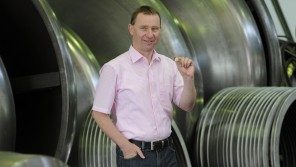
Günter Hommel, one of the general managers at the metal spinning company Jakob Hommel GmbH Metalldrückerei in Bad Überkingen, is used to explaining what he does. “In metal spinning we first rotate a circular metal disk at high speed. Then we apply pressure to reshape it, not much different from shaping clay on a potter’s wheel.”But instead of using hands to form the material, metal spinning uses a levered tool. A roller is mounted at the end, applying pressure in a closely controlled fashion to reshape the material. The results are seamless round shells that are rotationally symmetric.
Family ties
As exotic as the process might seem, the spun or turned metal parts are everywhere in day-to-day life. This family firm, founded in 1946, fabricates the caps topping light poles or church steeples, claddings for portable X-ray units, funnels for coffeemakers, the woks for Stefan Raab’s TV show “World Wok Championship”, and much more.
Günter Hommel proudly lists the places where his products are found. He was more or less born into a career in metal spinning since his father and grandfather were both turners. “There must be a virus in the family,” Hommel chuckles. But he was more than happy to carry on the tradition. “This profession is very creative and diverse. And you can’t learn the trade from books or in school.” Experience is far more essential and this father of two gained that experience through years of practice.
A feeling for the materials
Whereas spinning used to involve a large amount of manual work, PNC and CNC turning machines handle many assignments nowadays. In spite of this, Hommel feels that learning manual spinning is an indispensible part of apprenticeship training. “That’s the only way to get a feeling for the materials and truly understand how to turn flat sheet metal into a real product.”
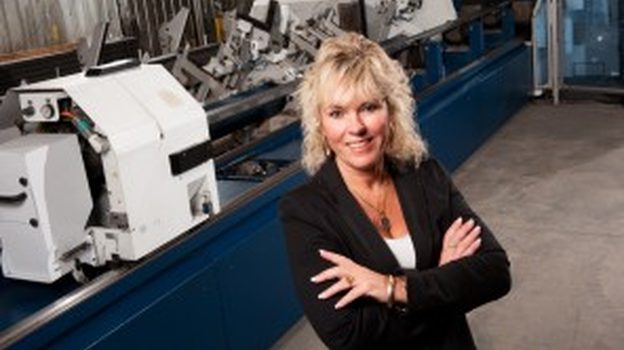
Using different tools Hommel works disks of up to 3,000 millimeters in diameter, at initial thicknesses of up to 5 millimeters for stainless steel.
Human muscle is no longer sufficient for many of the turned parts required today. The Hommel GmbH after all works disks of up to 3,000 millimeters in diameter, at initial thicknesses of up to 5 millimeters for stainless steel and as much as 10 millimeters in aluminum.
A powerful team
Whenever a particularly challenging assignment is in the works, Günter Hommel likes to gather his staff for a brainstorming session. Ultimately they present an exceptional solution to the customer. “I feel right at home on the shop floor. And since there are many experienced people on the team, who all pull together, we often devise solutions that previously seemed impossible.”
Hommel can also count on his family’s full support. He solicits his wife’s opinion on many decisions, cousin Michael is the technical manager, and one of his two sons is already at work in the business. It’s quite understandable that Hommel thinks about the future. “Of course I’d be glad to know that one or both sons decided to take over the business. But I’d be just as happy with a different decision.”
Any questions?
Contact us: MastersofSheetMetal@trumpf.com
This article was first published in autumn 2012.