
 (Please let us have your feedback.)
 Loading...
Grand entrance
Manufacturers and job shops in Brazil have one thing in common: They are looking to the future with great optimism.
Brazil is getting ready for two major sporting events. The World Soccer Championships are rapidly approaching, taking place in 2014. And just two years later, this South American nation will host the Olympics. The world will be both spectators and guests. It will be necessary to house and move more than a half million visitors during the World Championships alone.
Seven solid-state lasers
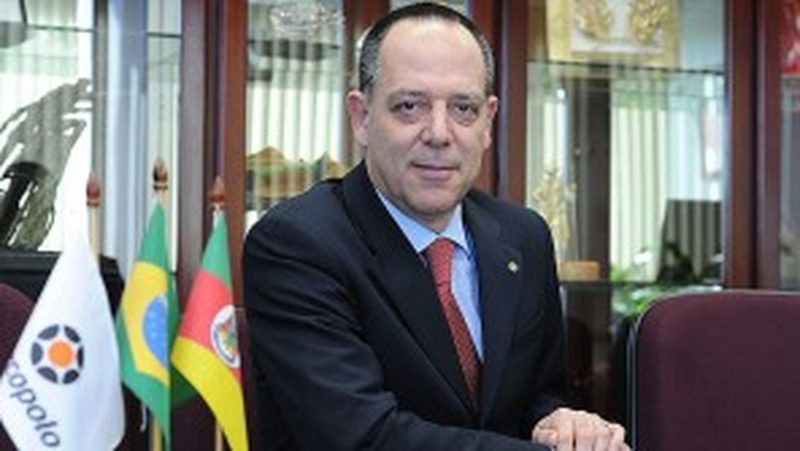
That spells good times for Marcopolo, since it builds a vital product: bodies for buses. “This is definitely a growing market,” says Marcopolo general manager José Rubens de la Rosa. “New, comfortable, safe and economical vehicles are what’s needed for those up-coming athletic events.” To meet soaring demand, this manufacturer — headquartered in Caxias do Sul — is massively expanding its production capacities. “We will be investing about 270 million euros between 2008 and 2015.” Seven new TruLaser 5030 fiber 2D machines featuring solid-state lasers are a part of the package. They are an important element in the company’s strategy, de la Rosa emphasizes. “We set ourselves apart from other manufacturers with our development and manufacturing processes. For us, having the most modern equipment is an absolute ‘must’.”
Important basis: the employees
Marcopolo is also investing in its employees’ skills, and there are about 18,000 of them all around the world. In the company’s own vocational training school, the Escola de Formação Prossional Marcopolo, the firm has trained more than one thousand young newcomers in the past twenty years. Today there are four additional schools — all around the planet.
The company’s busses are on the road there, too, since Marcopolo delivers to transportation companies in one hundred countries. Especially in his own country, de la Rosa is looking forward to a highly successful phase. “Brazil will be growing,” confirms Robson Braga de Andrade, President of the National Industrial Confederation. “The Olympic Games and the World Championships require major structural investments and that means new business opportunities.”
Trucks on the rise
Marcelo Facchini has a similar view of the future. His firm, located in São José do Rio Preto, will also be profiting from the boom triggered by the World Championships and Olympic Games. Not only is Brazil building stadiums; it is also making significant improvements in the entire infrastructure. Trucks are in heavy demand and Facchini builds the appropriate bodies and superstructures. Dump trucks, tank trucks, and semi-trailers are delivered to South American and African companies involved in agriculture, construction and freight forwarding.

As the general manager of Facchini S.A., Marcelo Facchini is banking on highly skilled employees, growth, professionalism and authenticity.
“After two years of stable growth and a brief slump, we are looking forward to growth once again in the second half of the business year,” he notes. Two new production sites are on the point of completion. “We have more than forty standard body models in the line. They can help our customers become more productive, even when dealing with shipping tasks that are out of the ordinary,” Facchini stresses.
Prepared for growth
With a staff of 4,382, nine production sites, thirty authorized dealers in Brazil, and ten others in foreign countries, the firm is prepared for growth. Sheet metal manufacturing operations work with nine 2D laser cutting machines made by TRUMPF. These are to gradually supersede the guillotine shears. The strategy for the future? “We place our bets on highly trained employees and modern machines, on growth, professionalism and authenticity. All these factors are grounded in our strategic planning.”
Partner instead of producer
Almir Ciarrocchi decided to hold true to his principles. That was a pivotal decision for the orientation of his company, CCS Tecnologia e Serviços LTDA, located in Limeira. “A while back we had an opportunity to put our own products on the market. But instead we decided to continue doing exactly what we do best: being a service provider.”
In that way he earned this customers’ trust as a highly reliable partner. Together with his nine hundred employees, the job shop today manufactures parts and assemblies for the automotive and construction industries, agriculture and railroads; it manufactures ATMs for banks and components for generators.

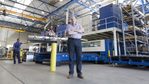
CCS general manager Almir Ciarrocchi has remained true to his basic tenets: “We decided to do what we’re best at and are continuing as a service provider.”
Experts in sheet metal
The company is just as broadly based in terms of technology. Laser cutting, punching, bending, welding, and surface finishing are all within the spectrum. “We already had more than thirty years of experience in manufacturing metal frames. Then we had an opportunity to take part in a project where it was necessary to implement laser cutting,” Ciarrocchi recalls.
CCS took up the challenge and laser technology premiered on the shop floor — in the form of TRUMPF machines. Today there are 26 of them. They are augmented with three TruPunch punching machines and two TruBend press brakes. “We started out with machines made by a number of manufacturers, but those made by TRUMPF were the most convincing,” Ciarrocchi explains. “Sticking to a single supplier makes maintenance work far easier.”
Expansion is proceeding
Like Facchini, he is also looking forward to an upturn in the second half of the year — and the expansion of production floor space from 40,000 to 51,000 square meters is proceeding apace. In this way Ciarrocchi is pursuing a strategy that Weber Porto, president of the German-Brazilian Chamber of Commerce, endorses: “Companies need to reduce their costs and, at the same time, achieve solid growth. Investments in modern production equipment and innovative processes are the key.”
New sites
The job-shop Cortemetal in Curitiba is taking a slightly different path. “Our goal is to set up new sites in other regions. We want to be closer to the customer.” That’s how general manager Pablo Vicent Pereira Motta explains his strategy. “The existing three production locations, with their strength and sustainability on their local markets, are the basis for our plans.”

Pablo Vicent Pereira Motta is quite successful in niche markets with Cortemetal. He intends to expand on this advantage with new operating sites.
Like CCS, Cortemetal has also made a name for itself as a job shop. Originally the enterprise developed solutions for the electrical and telecommunications industries. Machining sheet metal with laser units offered a chance for greater breadth. Today the operations in Londrina, Curitiba and Manaus produce mechanical components for agriculture, for the automotive industry and for electrical equipment.
A gobal audience
Small and medium sized firms make up the clientele. Motta describes his strategy: “There are niches where we can bring our advantages to bear, in spite of tough competition. That is one reason for our broad diversifiation.” Large-scale marketing campaigns are how Cortemetal intends to win over new customers and 1.4 million euros have been earmarked for this purpose. The timing seems to be perfect, since the world will have its eye on Brazil in 2014 and 2016.
Any questions?
Contact us: MastersofSheetMetal@trumpf.com
This article was first published in summer 2012.